The Message from France’s Stop Bure! ““We Will Not Surrender”: A 30-Year Battle Against Nuclear Waste”
Read the orginal in French from Reporterre here
Google translated in English below:
“We Will Not Surrender”: A 30-Year Battle Against Nuclear Waste
“We Will Not Surrender”: A 30-Year Battle Against Nuclear Waste
Opponents of radioactive waste disposal are gathering near Bure for a weekend under heavy surveillance. It is an opportunity to say “no” once again to Cigéo—a project whose problems threaten to become a burden for the coming century.
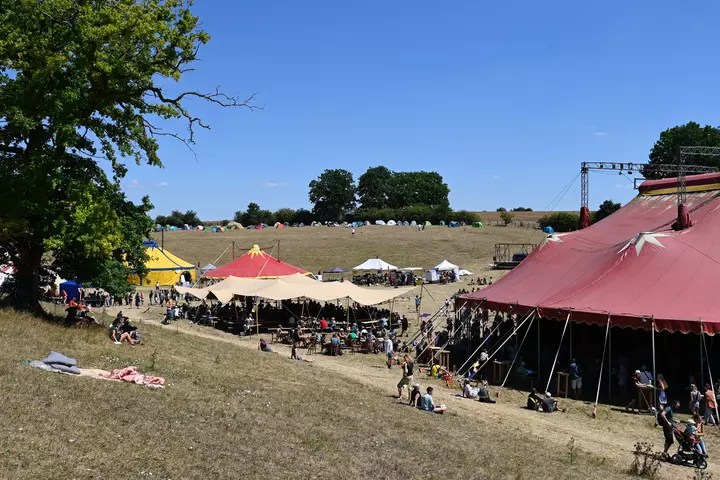
This weekend, in a field in Saint-Amand-sur-Ornain (Meuse)—about fifteen kilometers from Bure—people will discuss nuclear waste, attend lectures and concerts, watch films, and, above all, say “no” once more. From August 14 to 16, the fifth edition of “Bure’lesques” is bringing together opponents of the Cigéo project. This massive facility is intended by the State and the National Agency for Radioactive Waste Management (Andra) to be excavated 500 meters underground to bury the most dangerous radioactive waste produced by France’s nuclear power sector.
The event will take place under tight surveillance. Two decrees issued on August 4 by the Prefect of Meuse established an extensive police operation: bans on transporting various materials (such as wood), pyrotechnic devices, or items used to conceal one’s face; alcohol restrictions; and the capture and recording of images via two drones and a gendarmerie helicopter.
Read also: “We lost a battle but not the war”: how anti-nuclear activists are continuing the fight
Around forty individuals and fifteen organizations—including the Human Rights League (LDH), the French Lawyers’ Union (SAF), and the “Sortir du nucléaire” (Exit Nuclear Power) network—had filed an urgent appeal (référé-liberté) with the Nancy Administrative Court, denouncing the measures as disproportionate and characterizing them as a new attempt to criminalize opposition to Cigéo. According to the plaintiffs, certain bans covered 23 municipalities and an area of roughly 300 km²—even though the festival takes place in a field!
On August 12, the administrative court ruled in their favor on just one point: the use of sound equipment would be permitted. That is the bare minimum for a festival. As for the rest, the court deemed that the use of drones and a helicopter was not “manifestly disproportionate,” given the context surrounding the opposition to Cigéo.
“We will not give up”
This has reinforced the feeling among opponents that they are being monitored far beyond just their actions over the weekend. After all, the standoff with the State in Bure is nothing new. For nearly thirty years, the project has been accompanied by public meetings, legal challenges, protests, occupations, lawsuits, and police checks. Generations of activists have now taken up the cause against an industrial project whose timescale is enough to make anyone lose heart.
Reporterre has long followed this battle—witnessing moments of jubilation and victory, as well as harsh crackdowns. In the 2000s, opponents bought an old farmhouse to build a “house of resistance,” creating a permanent living space and a focal point for anti-nuclear struggles. In 2013, a boycott of the public consultation gave the movement fresh momentum, and in 2016, the occupation of the Lejuc woods stalled the project for nearly two years—before a barrage of lawsuits and “criminal conspiracy” charges attempted to stifle the fight. Since then, mobilizations have continued, and opponents are still looking for a way to block the project.
“The mindset is to keep fighting,” asserts Corinne François, a member of the Burestop collective, which is co-organizing the festival alongside a host of other associations. “This edition is significant; we are at a pivotal moment: the construction authorization decision (DAC) could be granted in late 2026 or 2027.”
“The mindset is to keep fighting.”
“We will not surrender,” insists Régine, from the Stop Cigéo coalition, who has over thirty-five years (!) of activism under her belt. That is practically a lifetime spent pointing out that this monumental project is a one-way ticket to ad vitam æternam—eternal—harm. “Residents need to understand that as soon as Andra obtains its authorization, work can begin immediately, starting with the clearing of the Lejuc woods. Massive construction projects loom on the horizon.”
If Cigéo goes ahead, it is slated to operate for at least a century. The repository will then be sealed to isolate substances from the biosphere—substances, some of which will remain dangerous for hundreds of thousands of years. Here, time does not quite have the same quality as it does elsewhere. The site’s safety will have to become passive: one cannot count forever on technicians, a State, institutions, or even a civilization to…


Leave a comment