by A Quiet Resistance
Our ‘SpringWatch’ walk at Ponsonby Tarn, NWS’ ‘Area of Focus’ for nuclear dump
It is a peculiar thing, that people will oppose something relatively benign, simply because they can see it. Yet, they will happily allow something much more malevolent and longer lasting, because they cannot imagine its awfulness. Or, because they do not believe it will affect them directly.
The beautiful ‘Area of Focus’ at Ponsonby
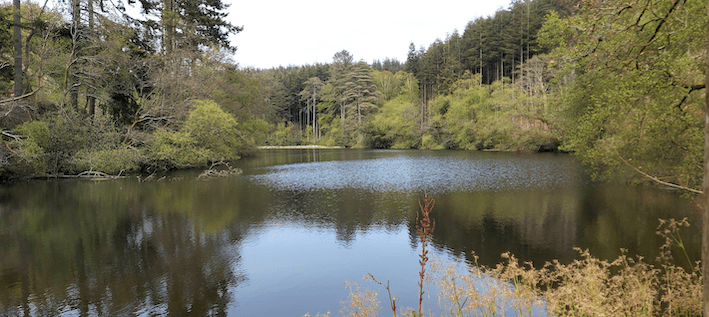
The little-known Ponsonby Tarn is a gorgeous man-made tarn, around the same age as Tarn Hows. It, and the 50+ hectares around it are directly in the Nuclear Waste Services (NWS) ‘Area of Focus’ for the Geological Disposal Facility (GDF) nuclear dump.
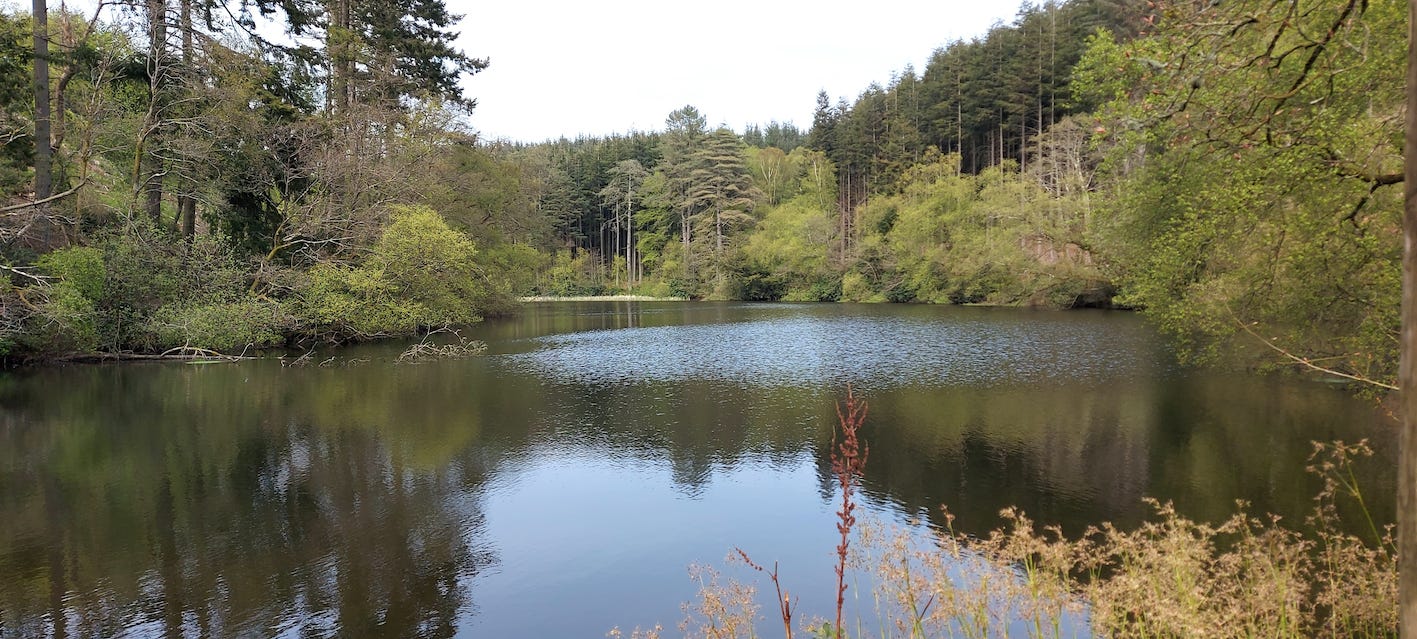
Ponsonby Tarn: by Kevin
By ‘Area of Focus’, means the area upon and under which will contain the surface works and drift tunnels leading to the 50 km2 under-seabed mine planned to contain all 140 tonnes of waste plutonium, plus various military and naval detritus, including at least 27 submarine hulls, and a range of other intermediate and higher level radioactive waste.
Unrelatedly—but somehow relevant—a recent application to install an 11.8-metre wind turbine at nearby Laverock How, in Ponsonby, was refused by the Lake District National Park Authority. On appeal, the Planning Inspectorate also dismissed it, claiming that the turbine would cause an ‘adverse effect on the character and appearance of the World Heritage Site’.
There’s an irony here, a deep, dark, malevolent irony.
‘SpringWatch’ at Ponsonby Tarn
Anyway … on Sunday, the bright and welcoming weather saw a small group of us gather to walk the area of focus, all of us curious to see more closely what we’re all set to lose if the government and nuclear industry get their way.
With that in mind, we took cameras, art materials and a cheerful attitude, and walked from the Lion and the Lamb in Gosforth, up Hardingill, and across the A595. We dropped down a side road, past JC Hope at Town End and onwards along the bridleway, surrounded by centuries-old hedges and lush farmland flowing with waves of velvet grass.
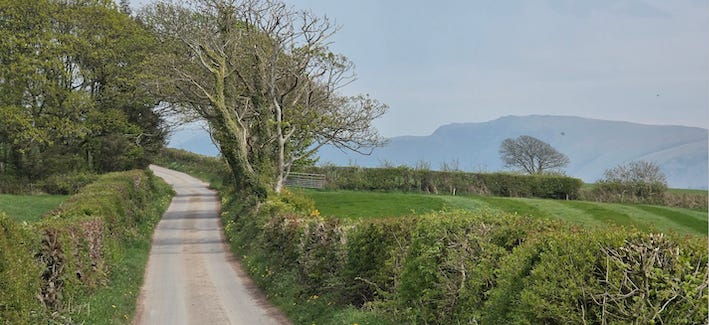
Looking Back Along the Bridleway: by Andrea
A half-mile down the concrete road, plastic signs warning of armed police patrolling at ‘unpredictable times’ lent a certain flair to the excursion. My seven-year-old demanded to know what ‘unpredictable times’ meant. She wondered if they were hiding behind the hedges, waiting to leap out—so she certainly understood the inference.
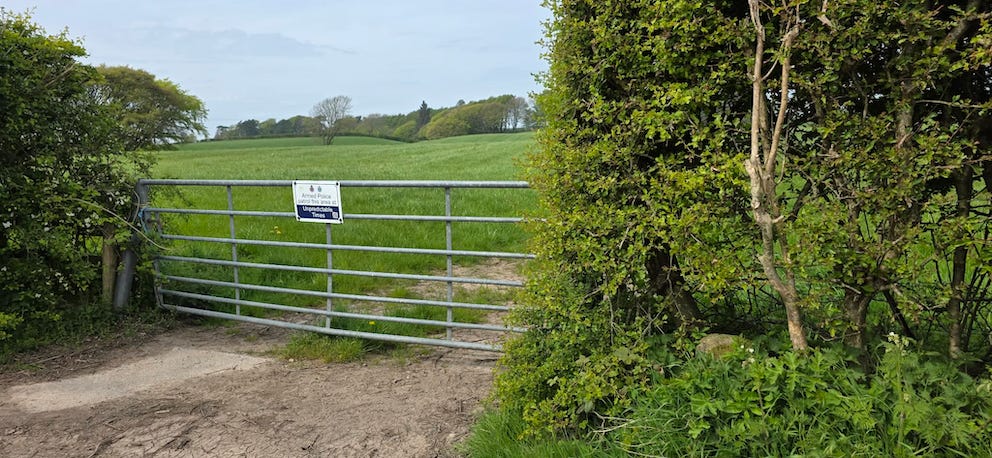
Armed Police patrol this area at Unpredictable Times
We took a sharp right at ‘Commander’s Lonning’—locally named for Commander Hugh Falcon-Steward—which presented us with an entirely different environment from the starkly exposed track. The woods around us were largely deciduous, a profusion of bluebells, stitchwort, and dandelions nodding beneath the trees. We found an old industrial structure, perhaps a well, or related to water, in line with a distant pump across the field.
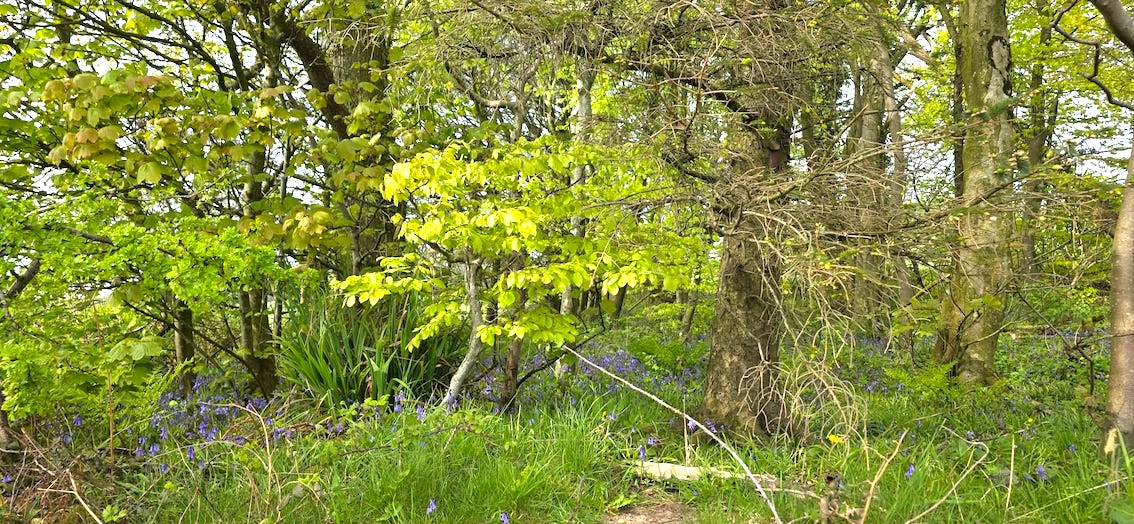
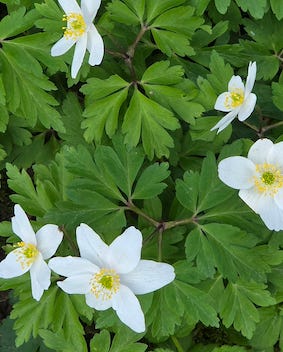
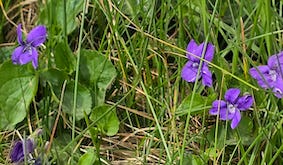
Bluebells, Wood Anemone and Violets: by Andrea
Carrying on down the road, a recently lived in, but now completely boarded up house, Saddlebank, with gorgeous gables in red sandstone, complete with a semi-walled garden. The stable-style sheds and yard lay melancholy, a single magnolia tree in the centre of a tiny lawn, pink blossom candles lit in the sunshine.
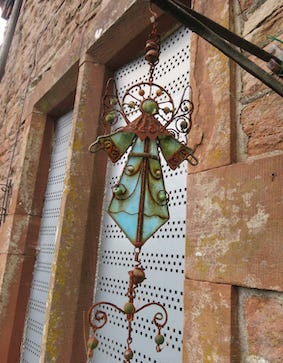
Saddlebank, Angel Door Charm: by Marianne
It’s understood that the house and the entire surrounding area belongs to the nuclear industry, so the industrial-style steel boards protecting its windows were expected, if out of place.
A few steps further, and another bleak reminder of Cumbria’s history lost: Newton Manor, its foundations and stone porch alone marking its existence. Built originally between 1868 and 1890, over the footprint of an 18th century farmhouse known as Low Lingbank, Newton Manor had been remodelled and extended in a gothic style in 1907, by the Falcon-Steward family. Its demise had been initially caused by water ingress through the roof, so when the Nuclear Decommissioning Authority acquired it through compulsory purchase, it was abandoned, and then demolished, without any attempt to restore, despite the money that had been spent to create it.
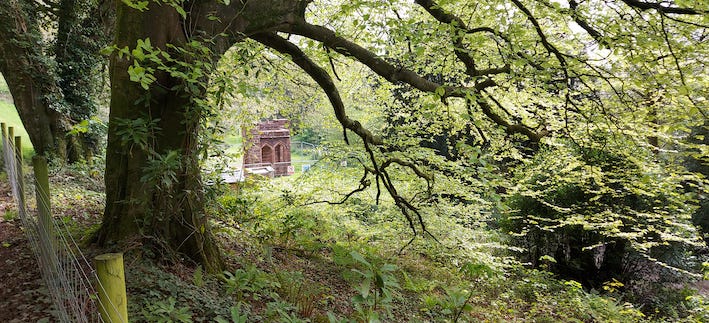
Newton Manor remains: by Kevin
Today, even the interpretation board was enclosed in industrial safety screens, too far away for the information to be seen by even the sharpest eyes. It seems the plinth for the board was laid with the sandstone coat of arms, which was subsequently damaged by water. A metaphor for the GDF plans? Water will be one of their biggest challenges. Still, we got to watch young squirrels playing and showing off their aerobatic skills in the trees. One notably gigantic hazel tree teemed with them.
We continued our pilgrimage towards the tarn, passing on to the next left track alongside Lingbank Moor, down a gradual slope. Much evidence of pheasant breeding, with plastic feeders every few metres. We soon came to a cross roads of tracks, which taking the immediate left, led us to the tarn itself.
And what a beautiful oasis. Tall bull rushes and reeds at the further end, a rough bench to rest on and draw the scenery. An amazingly well-constructed tiny bridge leading to nowhere. Honking geese flew overhead, while all around us chattered blackcaps, wrens, robins, chiffchaffs, and the occasional mournful pheasant.
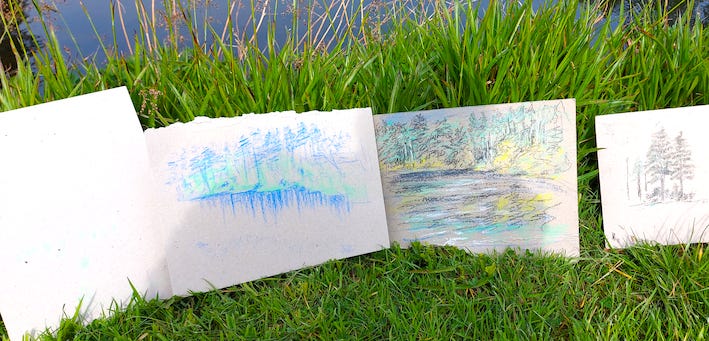
Drawings in Progress
Sound and Vision of Ponsonby Tarn
We wandered further around the tarn by the track, noting the signs warning us of phytophthora ramorum tree disease, and similarly the pheasant shooting-related numbered signs. We were glad not to see piles of shot and abandoned pheasants. Apparently game shooters are not encouraged to eat the birds they shoot here. Can anyone guess why?
Although we planned to return via the public footpath, crossing Newmill Beck proved to be too much of a challenge: the bridge was deconstructed with only steel girders in place. While most of us could have made it across, we didn’t want to leave any member of the party behind, so we returned the way we came.
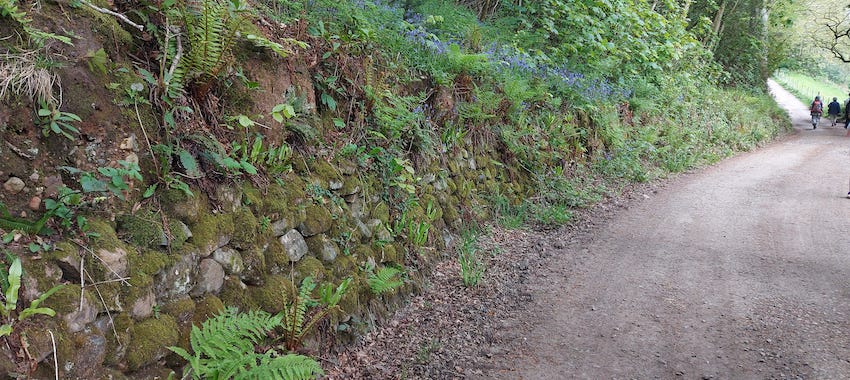
“Area of Focus” for the UK’s biggest infrastructure development, lonning, ancient wall and bluebells.
How can a nuclear dump be a more attractive option than a wind turbine?
The area of focus really is a beautiful place, full of owls, small birds, small mammals, and gorgeous plants and trees. It’s understandable that the Lake District National Park Authority would challenge a large wind turbine, as its incongruous stalk could interrupt some of the valued tourists’ views from above.
But what do they think the surface works of a nuclear dump will do for the scenery?
Does the LDNPA believe that the NDA will simply throw up some prefab buildings and that all the work and noise and industry will happen underground and under the sea three miles away?
Do they think that no-one will subsequently be disturbed by the activity in the centuries to come? What does the future of Ponsonby look like in the imagination of LDNPA officials?
When nuclear disaster is slow moving instead of sudden and dramatic
Our walk took place on the 40th anniversary of the Chernobyl disaster. I was 8 years old when that happened. My mum bought all of the powdered milk in our local Spar shop that day, and she, being a farming contractor, also tested sheep on the West Coast for radiation over the next 20 years.
Such a dramatic event warrants curiosity, but pollution events are frequently undramatic. The drip-drip-drip of poison often accumulates first in water, which is then distributed throughout the ground, deep below at first, but not forever. Much is made of iodine-131 whenever there is a nuclear emergency, but it is caesium-137 and strontium-90 that accumulates in soil and is uptaken by plants.
The hydrogeology of the Lake District is so complex that a dye placed in a beck near the Irish Sea reportedly reappeared in a spring near the top of a fell. Modelling has shown that heated groundwater rises, with contamination from an undersea dump likely to appear on the surface relatively quickly.
To endorse a nuclear dump here, is to condemn the people and wildlife to short-term, cancer-ridden lives. Permanently damaged DNA, resulting in unusual, and sometimes incurable diseases. Perhaps not this generation, but maybe the next.
We should be so lucky as to experience a nuclear emergency where we might all be evacuated, lose our homes and our beloved countryside, but get away before our lives are deniably shortened. A nuclear dump under our feet will provide delayed feedback—because it takes time for disease to develop— enabling government denial and, crucially, dismissal from the people themselves.
And once the process has begun, and the poison has been ‘emplaced’, it will not be possible to bring it back out.
We have to stop it now.
Guest Article by A Quiet Resistance


Leave a Reply